Friday, June 27, 2014

Èkpé and Abakua with Chief Dr. Ivor Miller, Asukuo Ukpong and Roman Diaz.


In recent radio show here in New York I had the opportunity to broadcast from the home of Afro Cuban master drummer  Mr. Roman Diaz. We sat down with Chief Dr. Ivor Miller, Asukuo Ukpong, Pan-Africanist, architect and scholar, to discus the nature and context of select Calabar Highlife and urban styles of Cuban Son that feature Èkpé and Abakuá themes. Click on the links below to hear the programs. You may also download the archive if you like.


 Tuve la dicha de transmitir dos programas con ilustres maestros de las sociedades Èkpé y Abakuá, reunidos en  casa del maestro Roman Diaz, para llevar a la luz la raiz y el contexto de temas culturales dentro del genero Highlife de Calabar y el Son urbano de Cuba. Escuchemos la influencia del Èkpé y el Abakuá, respectivamente, llevado por custodios de la cultura como eran Ekpe Ita y Ignacio Piñeiro. Dos generos tan importante en la cultura popular en ambos lados del atlantico. El Embakara, Dr. Ivor Miller de la Universidad de Calabar y el señor Asukuo Ukpong del Calabar, junto a el maestro Roman Diaz, hablaran con mucha profundidad sobre este tema  para todos aquellos que aman esta cultura, llevenadola siempre a los niveles mas altos de la esfera socio-cultural.


Abasi menguame,

 Onel Mulet

 http://www.blogtalkradio.com/blackwholeradio/2014/05/30/habana-harlem-live


  http://www.blogtalkradio.com/blackwholeradio/2014/06/06/habana-harlem-live

Tuesday, January 8, 2013

Abakúa day in Miami Florida. Jan. 6 2013.


This is a brief depiction of an Abakúa masquerade portrayed by Angel Guerrero Aberiñan Itia Mukanda. Members ,from most if not all of Cuba's Abakúa potencias (lodges), exiled in Miami are present at this gathering which happens once a year in commemoration of Colonial Cuba's Three Kings Day processions. During this day of celebration all the Cabildos, Potencias, Ile's and various mutual aid societies would bring out their finest regalia, drummers, dancers and chanters in order to win favor with the Governor who would then bestow upon their respective nation group the Aguinaldo( gift of gold coins)which they would  each in turn use to buy the freedom of their enslaved compatriots.

 The Dia de Reyes(Three Kings Day)celebration was suppressed after the abolition of slavery in Cuba. The Abakúa day tradition is a way of maintaining those values of fraternity alive. The Cuban's combination of  innovation and  orthodoxy in regard to their Èkpé traditions has ensured the survival of the seed planted in Cuba by Qua, Ejagham, Efut and Efik people over 500 years ago. The fact that it does not exist in the U.S., in it's ritual context, is insignificant when you consider that these traditions remain in the hearts and souls of men who, wherever they may go, continue to remain true to the vows they took on the day of their initiation, upholding Bongo Itá. I would like to extend special thanks to Angel Guerrero Aberiñan Itia Mukanda, and all the ekobios present on that day for welcoming me and allowing me to partake in the contagious joy.


Asere Nunkue, Okobio Eyenison
Abasi Menguame,


Onel Mulet  for The Voice of The Leopard.

Monday, August 27, 2012

Cuban and Cameroon Ékpè in DC


 This past weekend has been an important one for Abakuá and Ékpè members alike.  Here are images and music from all the encounters between Cuban Abakuá Roman Diaz and Angel Guerrero accompanied by a song they learned from Sisiku Assám Assám .  In just a little while Dr. Ivor Miller will be presenting his talk as Senior Fellow at the Smithsonian museum. We are very grateful to Dr. Johnnetta Cole and all the staff at the National Museum of African Art. Soon I will post more video and pictures of the events following Chief Dr. Ivor Millers talk.

Abasi Menguame,

Onel Mulet
for The Voice of The Leopard.

Wednesday, August 22, 2012

Senior Smithsonian Fellow Chief (Dr.) Ivor Miller Presents.....


                           November 25th Event with Cameroon Èkpé and Cuban Abakuá


Monday 27 August at 2:00pm at the Smithsonian Institution's NMAfA’s Lecture Hall

950 Independence Avenue, SW
Washington, D.C. 20560
For Directions Click Here<http://africa.si.edu/about/parking.html>


Chief (Dr.) Ivor Miller will present new research on Cross River civilizations and their manifestations in the Diaspora. Also featured are the music and masquerades of both Cameroon Ékpè and Cuban Abakuá. Musicians 'Román' Díaz, Ángel Guerrero  with NY based musician, composer Onel Mulet will participate.
For centuries, the Ékpè ‘leopard’ society of the Cross River region in southeastern Nigeria and southwestern Cameroon was the supreme institution of governance that also embodied esoteric teachings about the life-cycle. African migrants in colonial Cuba recreated Ékpè in the early 1800s to protect members in a slave society and to gain their freedom. They called it Abakuá, after the Àbàkpà community of Calabar, Nigeria. During this process, Abakuá scribes documented large portions of their cultural history in 19th century manuscripts. Hidden from outsiders until recently, this little-known ‘people’s history’ is being shared with West African cultural leaders who are using it to understand their own pre-colonial traditional institutions and arts.

With reference to photographs in the NMAfA collections, Chief (Dr.) Ivor Miller will present key themes of this story with the support of traditional intellectuals as well as musicians and dancers from Cameroon and Cuba. The foci will be on trans-Atlantic cultural identities, symbols of ‘universal motherhood’, and the functions of ‘life-giving’ drums. The role of the Museum as a link between continental Africans and African-descendants in the USA to explore their legacies in the arts will be addressed. Traditional chiefs from Cameroon who live in the Washington D.C. region will participate.

Sunday, July 8, 2012

Ntongho Eyang Ékpè


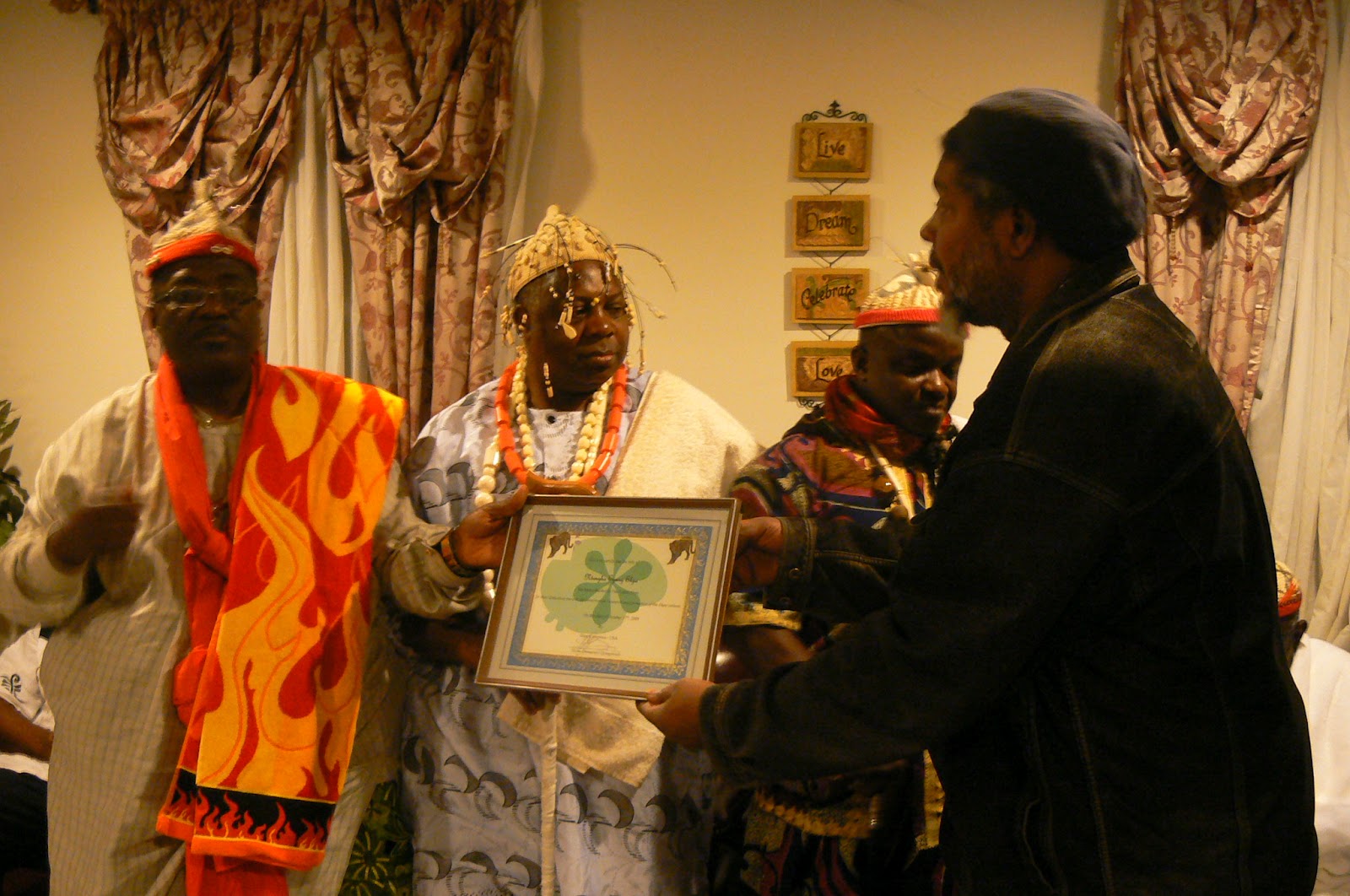
In November, 2011 several Ékpè leaders from Cameroon gave a certificate of recognition to their Cuban Abakua counterparts, that stated: “This is to certify that the title of Ntongho Eyang Ékpè has been awarded to the Cuban Ékpè, for their dedication towards the preservation, research and promotion of the Ékpè culture. On this day of October 17th, 2009. Signed Sisiku Emmanuel Ojong Orok.”

Ntongho Eyang Ékpè means ‘teacher of Ékpè’ in the Ejagham language of Nigeria and Cameroon.

The certificate had been created in response to the reunion of Cameroon Ékpè and Cuban Abakua at the CD release party for Eyenison Enkama at Joe’s Pub in NYC, but it wasn’t until 2011 that the two parties met again. The award was presented in the home and Ékpè lodge of Ékpè USA leader Sisiku Emmanuel Ojong Orok in Baltimore. It was received on behalf of all the Cuban Abakuá by Roman Diaz, who holds the title of Moni Bonko of Havana lodge Apapa Umon Ekori Tonko. For 200 years Cuban Abakua have preserved and maintained the traditions of their ancestors in Cuban Ékpè (Abakua) lodges spread throughout Havana and Matanzas. The very first Cuban lodge, called Efik Ebuton, was founded in the Havana neighborhood of Regla in the nineteenth century and was named after Obutong, an Ékpè lodge in Southeast Nigeria.


Roman Diaz is photographed here with Dr. Ivor Miller, Sisiku Philip Tazi (our gracious and most generous host), Sisiku Emmanuel Ojong Orock. This Ékpè ceremony commenced a week of activities with Ékpè U.S.A and Dr. Miller's talk "A Cultural History of Cross River Civilization" at the National Museum of African Art, Washington D.C., where he is currently a Smithsonian Senior Fellow. Roman Diaz was a featured artist along with Cameroon Ékpè masquerades, who were all graciously welcomed with introductory remarks by the Museum’s Director, Dr. Johnnetta B. Cole.

Wednesday, May 23, 2012

Chief Dr Ivor Miller and Chief (Mrs.) Anni Offiong on CRBC Television Calabar Nigeria 2012

 Chief Dr Ivor Miller and Chief (Mrs.) Anni Offiong on  CRBC Television Calabar Nigeria 2012

Part One


Part Two


Chief Dr. Ivor Miller talks about  the first ever Èkpé festival held in Cuba in May of 2011. In this interview he shares with us the significance of archives outside of Africa that preserve the rich, valuable history of Èkpé culture and displays rare late nineteenth and early twentieth century photographs of Old Calabar courtesy of the Eliot Elisofon photographic archives, National Museum of African Art, Washington D.C..  Chief Dr. Millers  exhaustive field work in Nigeria and Cameroon and his commitment to the culture allow him to shed  light on many important details about these rare photographs never before documented.

 I would also like to remind everyone that has not already purchased a copy of Chief Dr. Millers book " The Voice of The Leopard: African Secret Societies in Cuba(University of Mississippi Press)2009, you can now find it on paperback. The book describes Cross River and Èkpé history with great attention to  detail in the words of Chief Dr. Miller, elder Cuban Abakuá members and elder Èkpé men from the Cross River region.


Abasi Menguame,


Onel Mulet

for Ndibo Yeve Ngo

Wednesday, October 19, 2011

Dr. Ivor Miller On Greenpeace Radio Oct.3rd 2011


Dr. Ivor Miller On Greenpeace Radio Oct.3rd 2011


Kert Davies interviews Dr. Ivor Miller for Greenpeace Radio. He speaks about Afro Cuban culture and the environmental impact of a modern world on the forests of ancestral Èkpé lands in Nigeria and Cameroon. This is an uninterrupted version of the riginal Greenpeace radio podcast featuring the music of Arsenio Rodriguez, Celia Cruz, Enyenison Enkama and Victor Herrera. You will also hear a rare recording from Lydia Cabrera's archives later released on Smithsonian Folkways. Please enjoy.


Abasi Menguame,


Onel Mulet

for Ndibo Yevengo.

Tuesday, August 23, 2011

Nunkue Ayaya!! An Homage to the Morua!!!


In the deep heritage of Ekpé legend exists a perfectly balanced ritual lineage that preserves the richness of the Qua, Efik, Efut, and Ejagham. Wrapped in this womb are the traditions of the Ekpé societies and their sister Ndem societies. Careful stewards of both sides of the Kalunga line they are ensuring the survival of this profoundly rich cultural treasure trove for generations to come.

Last week thanks in great part to the generous help of Martin, Vivian, and Matt Cohen with the help of Javier Raez and Ben Baurer we were able to explore these very spiritual connections and pay homage to the Morua by joining the enormous talents and profound knowledge of both Maobong Oku and Roman Diaz in this piece so eloquently presented by Dr. Ivor Miller. Enjoy and thanks to all who have tuned in to Ene Ita's radio broadcasts with Dr. Miller and the re-broadcasts on Cuba Calabar Radio. More to come.

Abasi Menguame,


Onel Mulet

Friday, August 5, 2011

Sese Mariba Kondo:"The Voice That Comes From The Sea"


In April Enyenison Enkama performed a spectacular set at the Schomburg Center for Research and Black Culture. The enthusiastic crowd received the group with love and admiration as it revealed the traditional Abakuá masquerade and sang songs of praise for their comrades, the ancestors and the traditions that were brought from Ekpé lands in southeast, Nigeria and southwest Cameroon. Our dear friend inventor, entrepreneur and professional photographer Martin Cohen captured these images posted on his congahead.com blog. Cuban photographer Juan Caballero was there and captured these brilliant images. Cuban filmmaker and author Aristides Falcon also documented the event and video footage of the concert will be posted very soon. Download Ecobio Enyenison, the latest release by Enyenison Enkama(Roman Diaz, Angel Guerrero, Pedro Martinez) at the iTunes store.

Sunday, February 27, 2011

Ekpe Masquerade


I missed carnaval in Calabar this year, and this video reminds me of the stark majesty and power of Ekpe masquerades. The different Ekpe masquerades bring together the communities of the Cross river and it's diaspora year after year in honor of their common ancestors and Ekpe culture at large; transcending distance and time in the retelling of the founding traditions of Ekpe resonating with the voice.

Thursday, January 6, 2011

Three Kings Day: Abakuá day in Cuba


Three Kings Day circa 1850 painted by the french painter Frederic Mialhe.


Happy New Year!!! January 6th is Abakuá day in Cuba. On this day all the different cabildos and Abakuá lodges celebrate their different traditions, dances and masquerades during colonial times. It symbolized a subtle demonstration of power and numbers where the colonial governor would give the aguinaldo or the offering of gold pieces to each of the cabildos and lodges. They used their earnings to buy the freedom of captive brothers and sisters in bondage. For the Abakuá it is also one of the best examples of synthesis that laid the groundwork for a very sophisticated culture of resistance and adaptation.

Thursday, November 11, 2010

“Presence and significance of Èkpé and Abakuá societies in Cuba and America”

Below is a description, both in english and spanish, of the Colloquium, it's purpose, and the topics that will be addressed.

The organizing committee of the IV International Colloquium about Research in Afro-American Religions, through this circular invites all anthropologists, specialists, related researchers, scholars and religious persons, to participate in this event to be held in Havana, in the headquarters of the Cuban Institute of Anthropology, from May 25th to 28th next year.

Once again, it seeks to consolidate a space for exchanging knowledge and experiences on research and studies that have as its focus the diversity of religious forms, religions and cultural modes of recorded African history in America as a result of the colonial process. This time it will focus the discussion to the presence and meanings of traditional religious societies of southern Nigeria, Calabar region, that evolved in the semi-secret and religious groups called Abakuá in Cuba. The cultural influence of these societies in the American context as a result of successive migrations to different latitudes, will receive attention in the event as a way to establish the concepts that allow from these "societies" the development of human being-nature biopsychosocial equilibrium.

It is an opportunity to constitute several spaces for reflection and debate among scholars and researchers of the intangible and material cultural heritage contained in religions and in the cultural practice of the religious person with these beliefs.

It will also allow to initiate dialogical approaches on the religious cultural practice that it’s developing today in different latitudes under the Caribbean and Latin American influence, to encourage integration frameworks at the level of the regional area we live in, convinced that the development of cognitive abilities in this area may become a strategic point for the delineation of an integrating policy and of own nature from the Latin American cultural geography. That also is the reason why in the IV Symposium will be formed the Regional Group of Afro-American Religious Studies (GRERA) attached to the Cuban Institute of Anthropology


Thematic Categories:

1. Notions of the religious societies Egbe of Calabar and Abakuá in Cuba. Their ties with other Afro-American Religions. Major trends and approaches.
2. Experiences in the recognition of Afro-American cultural practices. Major problems and trends in the vision of Africa.
3. Scientific research applied to the study of African-American immaterial and tangible cultural heritage. The Afro-American culture and its reflection on the praxis of Science and Culture.
4. Education and training for the preservation and rescue of the Afro-American Cultural Heritage.
5. Environment in the Afro-American cultural practice. Practical problems. Education for cultural praxis.
6. Afro-American Cultural History. Main research topics. Image of the African descent and social problems that it entails.
7. African-American culture and sociocultural resistance. Contemporary ethnographic studies.
8. The African Diaspora in Latin America and the Caribbean.
9. Transnationalization and dissemination of Afro-American religions. Study cases in situational anthropology.

As part of the activities scheduled for the IV International Colloquium on Afro-American Religions Research there will be held:

1. Constituent meeting of the Regional Group of Afro-American Religious Studies (GRERA) attached to the Cuban Institute of Anthropology
2. Ethnographic audiovisual presentation on secret Abakuá societies in Cuba made by the Group of Afro-American Religions of the Cuban Institute of Anthropology.
3. Presentation of the photographic exhibition "Images of Abakuá" by Dr. Miguel Ángel García Velazco.

Sponsors:
- Cuban Institute of Anthropology.
- Social Science Council; Ministry of Science, Technology and Environment
- Spanish Agency for International Cooperation for Development.


Co-sponsors:
- Office of the Historian of Havana.
- UNESCO Regional Office for Culture in Latin America.
- Regional network of institutions and researchers of Afro-American religions.
- “Fernando Ortiz” Foundation.
- Africa House of the Office of the Historian of Havana.
- UNESCO Cuban National Commission.
- Yoruba Cultural Association of Cuba.
- Swiss Cooperation for Development (COSUDE).
- Higher Studies School of Hotel Trade and Tourism.
- Embassy of the Republic of Nigeria.

El comité organizador del IV Coloquio Internacional sobre Investigaciones de las Religiones Afroamericanas, a través de esta circular invita a todos los antropólogos, especialistas, investigadores afines, estudiosos y religiosos, a participar en este evento que se realizará en La Ciudad de la Habana, en la sede del Instituto Cubano de Antropología, del 25 al 28 de mayo del próximo año.

Una vez más, se persigue consolidar un espacio para el intercambio de conocimientos y experiencias acerca de investigaciones y estudios que tienen como foco la diversidad de formas religiosas, religiones y modos culturales de antecedentes africanos registrados en América como consecuencia del proceso colonial. En esta oportunidad enfocaremos el debate hacia la presencia y significados de las sociedades tradicionales religiosas del sur de Nigeria, región del Calabar, que devinieron en las agrupaciones semisecretas y también religiosas denominadas Abakuá en Cuba. La influencia cultural de estas sociedades en el contexto americano como consecuencia de las sucesivas migraciones hacia diferentes latitudes, será objeto de atención en el evento a manera de establecer las nociones que permiten desde estas “sociedades” el desarrollo de un equilibrio biosicosocial ser humano-naturaleza.

Es una oportunidad para constituir diversos espacios para la reflexión y el debate entre estudiosos e investigadores del patrimonio cultural intangible y material contenido en las religiones y la praxis cultural del religioso de estas creencias.

Asimismo permitirá iniciar acercamientos dialógicos sobre la praxis cultural religiosa que se desarrolla actualmente en diferentes latitudes bajo el influjo caribeño y latinoamericano; propiciar marcos de integración a nivel del área regional en que vivimos, convencidos de que el desarrollo de capacidades cognoscitivas en esta área podrá constituirse en un punto estratégico para el trazado de una política integradora y de naturaleza propia desde la geografía cultural Latinoamericana. Esa además, es la razón por la cual en el marco del IV Coloquio se constituirá el Grupo Regional de Estudios sobre Religiones Afroamericanas (GRERA) adscrito al Instituto Cubano de Antropología

Contenidos Temáticos:

1. Nociones de las Sociedades religiosas Egbe del Calabar y Abakuá en Cuba. Sus vínculos con otras Religiones Afroamericanas. Principales tendencias y enfoques.
2. Experiencias en el reconocimiento de prácticas culturales afroamericanas. Principales problemas y tendencias en la visión sobre África.
3. La investigación científica aplicada al estudio del patrimonio cultural inmaterial y tangible afroamericano. La cultura afroamericana y su reflejo en la praxis de la Ciencia y la Cultura.
4. Educación y capacitación para la preservación y rescate del Patrimonio Cultural Afroamericano.
5. Medio Ambiente en la praxis cultural afroamericana. Problemas prácticos. Educación para la praxis cultural.
6. Historia de la Cultura Afroamericana. Principales temas de investigación. Imagen del afrodescendiente y problemas sociales que encierra.
7. La cultura afroamericana como resistencia sociocultural. Los estudios etnográficos contemporáneos.
8. La diáspora africana en América Latina y el Caribe.
9. Transnacionalización y difusión de las religiones afroamericanas. Casos de estudio en la antropología situacional.

Como parte de las actividades programadas en el IV Coloquio Internacional sobre Investigaciones de las Religiones Afroamericanas se realizarán:

1. Reunión de constitución del Grupo Regional de Estudios sobre Religiones Afroamericanas. (GRERA) adscrito al Instituto Cubano de Antropología.
2. Presentación de audiovisuales etnográficos sobre las sociedades secretas Abakuá en Cuba realizados por el Grupo de Religiones Afroamericanas del Instituto Cubano de Antropología.
3. Presentación de la muestra fotográfica “Imágenes del Abakuá” a cargo del Dr. Miguel Ángel García Velazco.
Auspician:
- Instituto Cubano de Antropología.
- Consejo de Ciencias Sociales del Ministerio de Ciencia, Tecnología y Medioambiente
- Agencia Española de Cooperación Internacional para el Desarrollo.

Coauspician:
- Oficina del Historiador de la Ciudad de la Habana.
- Oficina Regional de Cultura para América Latina de la UNESCO.
- Red Regional de Instituciones e investigadores de las religiones afroamericanas.
- Fundación “Fernando Ortiz”.
- Casa de África de la Oficina del Historiador de la Ciudad de La Habana.
- Comisión Nacional Cubana de la UNESCO.
- Asociación Cultural Yoruba de Cuba.
- Cooperación Suiza para el Desarrollo (COSUDE).
- Escuela de Altos Estudios de Hotelería y Turismo.
- Embajada de la República de Nigeria.
Friday, November 5, 2010

Editors Pick on Descarga.com

EEcobio Enyenison
CD (Habana|Harlem 205976), Released 2009;
Editor's Pick:
Very Highly Recommended folkloric Abakuá release featuring Roman Diaz, Pedro Martinez, Angel Guerrero and guests. A rare album of its type, and continues where Cuba's Grupo Andabo's 1997 Enyenison Enkama 2 left off. Recorded in very high quality at the home of Roman Diaz and Pedro Martinez, NY, 2009. Those who are familiar with Ékpè and Abakuá hold this session in very high regard. The real deal. With Onel Mulet, Oriente Lopez, Ruben Rodriguez and many other noted musicians. Guests Steve Turre and Paquito D'Rivera. - BP

"...This recording by Proyecto Enyenisón Enkama is a brilliant effort to continue that conversation, using the same form in which both Ékpè and Abakuá have recorded their own histories: ritual phrases with symbolic rhythms. Members of Proyecto Enyenison Enkama have been leaders in the conversation with their African counterparts at each stage in the process, which certainly began before the first encounter in 2001. In 1997, the Havana rumba group Yoruba Andabo’s recording of ‘Enyenison Enkama 2’ (arranged and chanted by ‘Roman’ Díaz’) became the basis for the Brooklyn encounter; it included an historic chant evoking Efí Ebutón, the first Cuban lodge, that Nigerians interpreted as identifying ‘Obutong’, an important Calabar community. In 2000, Angel Guerrero led the creation of ‘Ibiono’ in Havana, the first full length CD devoted entirely to Abakuá ritual chanting that evoked historic lineages in Cuba and the foundation of Ékpè in Africa. Following this trajectory, in ‘Ecobio Enyenison’, Cuban Abakuá chant their history and proclaim their faith in their inherited traditions.

The phrases of each composition describe sacred geographies (maps) of West African source communities, as well as histories (epic deeds) of the African founders. By evoking these inherited chants, members of ‘Proyecto Enyenison Ekama’ praise their teachers, as well as all those Abakuá leaders of the past who maintained their faith in the teachings of those Carabalí migrants who established Abakuá. By chanting within the context of contemporary arrangements played by vanguard jazz musicians, they celebrate a cultural victory of continuity and evolution across time and space, as well as offer a vision of the expansion of their traditions into the future."

Dr. Ivor Miller
African Studies Center
Boston University
(DR, 2010-11-02)
Song titles include:
Eribo Eriboñe
Neri
Itia Fondova
Tumba Efo
Danza Ñañiga
Ekon Erima
Mariba Konkai
Beromo Ñampe
Isunekue
Iro Gañu
Musicians include:
Ramon Diaz Percussion
Pedro Martinez Percussion
Angel Guerrero Percussion
Onel Mulet Flauta, sax
Oriente Lopez Piano
Ariacne Trujillo Piano
Philbert Armenteros Lead vocal
Ruben Rodriguez Bass
Panagiotis Andreou Bass
Dennis Hernandez Trumpet
Eddie Venegas Violin, trombone
Willie Alvarez Trombone
Edmar Castañeda Harp
Alvaro Benavides Bass
Axel Tosca Piano
Category: Folkloric => Rumba And/Or Santeria/Lucumi
Shipping Value: 1
ORDER TL-24115.10 CD $16.98

Thursday, September 23, 2010

Calabar Radio Broadcast W/Ene Ita and Dr. (Chief) Ivor Miller #2

Thanks to all those folks who have been tuning in to the blog and our podcasts. I am now compiling transcripts of these transmissions; for those who are interested please email me at ndiboyevengo@gmail.com. In this weeks' podcast Ene Ita and Dr. (Chief) Ivor Miller talk about the shared traditions of Cuba and Calabar through Ékpè and Abakuá culture. Cuba's Abakuá music is maintained in epic poetic form, a tradition that has enabled Cuban Abakuá to maintain the memory of their ancestors. They also used it to survive the repression of a colonial government looking to strip them of their cultural identity, recording their own history in the hearts and minds of Abakuá members for generations to come and for our enjoyment in the 21st century nearly 200 years since the first consecration took place in Regla;Havana, Cuba.

Please click on the logo below to hear the podcast.

Tuesday, September 21, 2010

Images from Abijang, Etung S.E. Nigeria


A view of the Cross River from the town of Abijang, in southern Etung Local Government Area, between Ikom urban and the Cameroun border. Photo by Ivor Miller, 2010


Inside the Mgbe hall of Abijang, a copy of Voice of the Leopard is proudly displayed. The Mgbe members of Abijang supported Miller's research by performing rare funerary rites, and a photograph of the hall and their sacred Ukara cloth is published in Miller's book. Photo by Ivor Miller, 2010

Wednesday, September 15, 2010

Images from Dr. (Chief) Ivor Miller's Archives


Martin Cohen and Jesus Perez "Oba Ilu", Havana.
In the course of research on the history of the Lukumi bata drum ensemble in Cuba, specifically the legacy of one of its masters, Jesus Perez, Miller assembled a visual archive from the private collections of Perez's extended community. This one depicts Perez's happy encounter with Latin Percussion founder and photographer Martin Cohen of New Jersey.


Margarita Ugarte, founding member of the Conjunto Folklorico Nacional de Cuba, dances for Yemaya in Mexico. Margarita, a colleague of Jesus Perez, met Miller through Dr. Rogelio Martinez-Fure, Cuba's leading Africanist. Margarita was raised in an family that practiced Ocha and Abakuá in Regla, the town where Abakua was founded in the 1830s.

Friday, August 20, 2010

African Symbolism in Kanye West's Power Video


Kanye West's interest in the Illuminati and it's symbolism is no big mystery, at least not anymore. His latest video, Power, is his personal take on the abuse of Power and how those who have it keep the secrets very closely guarded. Since Medieval times historians have revealed many instances of secret societies. Most famous of all are the Illuminati, the Knights Templar and the Freemasons. The roots of Freemasonry can be traced as far back as ancient Egypt. Even with all his references to Masonic symbolism and images of beautiful half naked seductive women in this video, it's the presence of particular African symbols that stand out the most for me when I look at Kanye's 21st century Bacchanal.

West treats us to depictions of ancient Egyptian deities like Horus, god of the sky and Hathor the cow horned love goddess. Even more interesting is what Hathor does with the staff. This particular staff is very similar to those used in Bantu or Ki-Kongo traditions, also similar to the iton, (Ékpé staff) used by Ékpé title holders. B.E. Bassey (2001:19-28) mentions a correlation between the Nile river valley and the semi-Bantu Ekoi (Ejagham) one the many inhabitants of southwestern Cameroon and southeast Nigeria who practice Ékpé, their own secret society, known as the Leopard Society .Ékpé societies are the forebears of the Cuban secret society known as Abakuá.

The action of pounding the staff against the earth symbolizes communication with the spirits or ancestors. This form of communication is practiced throughout the African diaspora. Examples include but are not limited to; Umbanda traditions in Brazil, Vodou in Haiti, New Orleans and the Mayomberos of Palo traditions in Cuba, and the U.S.. A steady beat accompanies the mambo, a prayer or incantation used to communicate with N'fumbe(spirits) or summon the N'kisi(spirit or deity of the paleros charm or pot). The combination of the rythmic pulse of the sorcerers staff and the chanting of the mambo gets the message where it needs to go.


For more information about Ékpé and Abakuá check out these two books.


Ékpé Efik: A Theosophical Perspective.By B.E. Bassey Victoria. B.C.: Trafford Publishing 2001


Voice of the Leopard: African Secret Societies and Cuba (Carribean Studies) by Ivor Miller (Hardcover - Jan 16, 2009)

For information on Africa in the diaspora see Pierre Fatumbi Verger

For more information about freemasonry, the Illuminati and its symbols see United Symbols of America Robert R. Hieronimous Ph.D.


Onel Mulet for N'dibo Yeve N'go

Thursday, August 5, 2010

Blow Ékpè: Conjuring the voice of the leopard.


"In Calabar history, Ékpè say they 'blow Ékpé' (as translated from Efik). In his
book Efik Ékpè, Eng (Chief) Bassey equates the Voice sound with a trumpet,
metaphorically." Dr. (Chief) Ivor Miller


Click Here for M.H. Masts 1989 article on The larynx of roaring and non-roaring cats.


The larynges of the four 'roaring' cats, the lion, tiger, leopard, and jaguar,
can be distinguished from larynges of 'non-roaring' cats by a large pad of
fibro-elastic tissue which constitutes the rostral portion
of the proportionately very large vocal fold.

This paper presents a more detailed anatomical study of the larynx of all
species of the big cats and a representative number of small cats. The
structure of the vocal folds of the family Felidae are discussed in terms of
functional morphology, with 'roaring' versus 'non-roaring' vocalisation
described in principles of musical acoustics.

It was found that all species of genus Panthera ('roaring cats'), with the
exception of P. uncia, can be distinguished from 'non-roaring' cats by a large
pad of fibro-elastic tissue which constitutes the rostal portion of each of the
proportionately very large undivided vocal folds (Fig. 1 a). p. 118

Because of their large mass, the Panthera vocal folds - the sound generating
element - have a low natural frequency and, when vibrating, will produce a high
acoustical energy. p. 119

As in other species of the cat family, sexual differences are quantitative, with
the male larynx, on the average, larger than the female. P. 119

The entire vocal mechanism of the roaring Panthera, i.e. subglottic larynx,
vocal folds, supraglottic larynx, pharynx and open mouth, is analogous to the
brass trumpet. The Panthera vocal folds simulate the form of a trumpet
mouthpiece. The mouthpiece, when added to one end of the tube (supraglottic
larynx and pharynx), adjusts frequencies of the harmonics. The result is to
increase slightly the effective length of the tube and to cause the instrument
to behave acoustically like an open tube with a new length; the instrument
(vocal mechanism) will then produce a set of resonances which includes all the
notes of the overtone series (Berg & Stork, 1982).

The wide open mouth of the cat is analogous to the bell of the trumpet. Adding a
bell or wide open mouth to the cat's trumpet-like vocal apparatus provides the
correct match between instrument and outside air to transfer the sound most
efficiently; a bell also modifies the frequency and stability of the harmonics,
increasing their production and radiation (Bachus, 1977; Berg & Stork, 1982).

The configuration of an instrument employing a mouthpiece at one end of a
straight tube and a bell at the other end will produce a sound that is louder,
and a tone that is brighter and more 'trumpet-like' than any instrument that
lacks either a mouthpiece or a bell (Holmes, 1985). Finally, the replacement of
the epihyal by an elastic ligament in genus Panthera allows the larynx to be moved a greater distance from the tympanic bulla and is analogous to the modem valve brass trumpet or slide trombone, where every lengthening of the instrument by 6% will result in a decrease in pitch of one semitone i.e. about 6% in frequency (Bachus, 1977).P.120

Visit Dr. (Chief) Ivor Miller on Facebook and view his photographs of Calabar, its people, and surrounding areas of Cross River State. Dr. (Chief) Ivor Miller is a visiting Fulbright scholar from the African Studies center Boston University, conducting research in Cross River state, southeast Nigeria and many of the surrounding regions.

CRBC Radio Calabar Radio Programs with Ene Ita and Dr. (Chief) Ivor Miller


This weeks blog features one of many podcasts first broadcast by CRBC Calabar Radio. Dr. (Chief)Ivor Miller of the African Studies Center in Boston is a Fulbright scholar conducting research in the Cross river region of southeast Nigeria and Cameroon.
To listen to the podcast please click the Cuba Calabar Radio logo to the right.

His interviews with Ene Ita focus on Cuban Abakuá culture and its relationship to Ékpè societies in the Cross river region.

Saturday, July 31, 2010

Asere Nunkue: Abakuá and Ékpè presence in Cuban popular music.

Photo Credit:Joaguín Ordoqui García

Asere is an Efik salutation or greeting commonly used by members of the Abakuá society in Cuba. In more modern times it has become a term very closely linked to the Cuban identity, used as a greeting among close friends ,or brothers. Nunkue is an Efik word for capital(Roche) which the Abakuá in Cuba have adapted as an Efik name for Havana.

In the 20’s the Cuban Son was at the height of its popularity in Cuba. Due In great part to the technological innovations of the 78 rpm. Columbia records and Victor were both issuing recordings of sextetos from Havana in the 1920's. Unlike the larger Danzón orchestras of the time, the mobile nature of these smaller sexteto groups immediately made them very popular(Diaz-Ayala). Despite the reduced instrumentation the sexteto created a big enough sound to get the attention of the dancers and keep them on the dance floor. The strident and aggressive voices of Abelardo Barroso , Machin and Maria Teresa Vera proved to be adequately suited to these groups.

When the Son arrived in Havana it became very popular among the rumberos. Evidence of this can be found in the large number of sextetos that came out of neighborhoods like Jesus Maria, Cayo Hueso and Los Sitios located just outside Havana’s city walls. They were home to many of the Port of Havanas labor force and many of Havana’s Abakuá lodges. These extra mural neighborhoods produced some of Cubas most famous rumberos and rumba groups and spawned Sextetos like the Sexteto Habanero, Sexteto Machin featuring singer Abelardo Barroso, Sexteto Boloña, Sexteto Munamar, Sexteto Columbia, Sexteto Matancero founded by Issac Oviedo and Sexteto Occidente which featured some of Cuba’s first recorded Abakuá chants in a Son context. Penned by Ignacio Piñeiro (Havana, 21 May 1888 – 12 March 1969) Abakuá member of the Efori Nkomon lodge. The poet of the Cuban Son went on to form the Septeto Nacional de Ignacio Piñeiro in 1927 and became one of Cuba’s most celebrated arrangers and composers.

The lead singer and guitarist of the short lived Sexteto Occidente was Maria Teresa Vera (1895-1965). A star in her own right, she performed at the Apollo theater in Harlem at 23 years of age before an adoring crowd and went on to become the Mother of the Trova . She can be heard on the 27 recorded songs in Occidentes discography on Columbia Records starting in 1926.

The podcast features two of Cubas legendary sextetos. Sexteto Occidente and Sexteto Habanero. The latter is the only existing Cuban sexteto. We end the podcast with another Ignacio Piñeiro composition ushering in the era of the Septeto with his Septeto Nacional. These selections come from the collection of Dr. (Chief) Ivor Miller author of Voice of The Leopard, where you may find a detailed account of the compositions below and their Abakuá influences.


---------------------------Onel Mulet for N'dibo Yeve Ngo


Podcast Tracks


Los Cantares del Abakua (Sexteto Occidente)
Criolla Carabali (Sexteto Habanero)
En La Alta Sociedad (Sexteto Occiedente)
Efi Embemoro (Septeto Nacional Ignacio Piñeiro)